

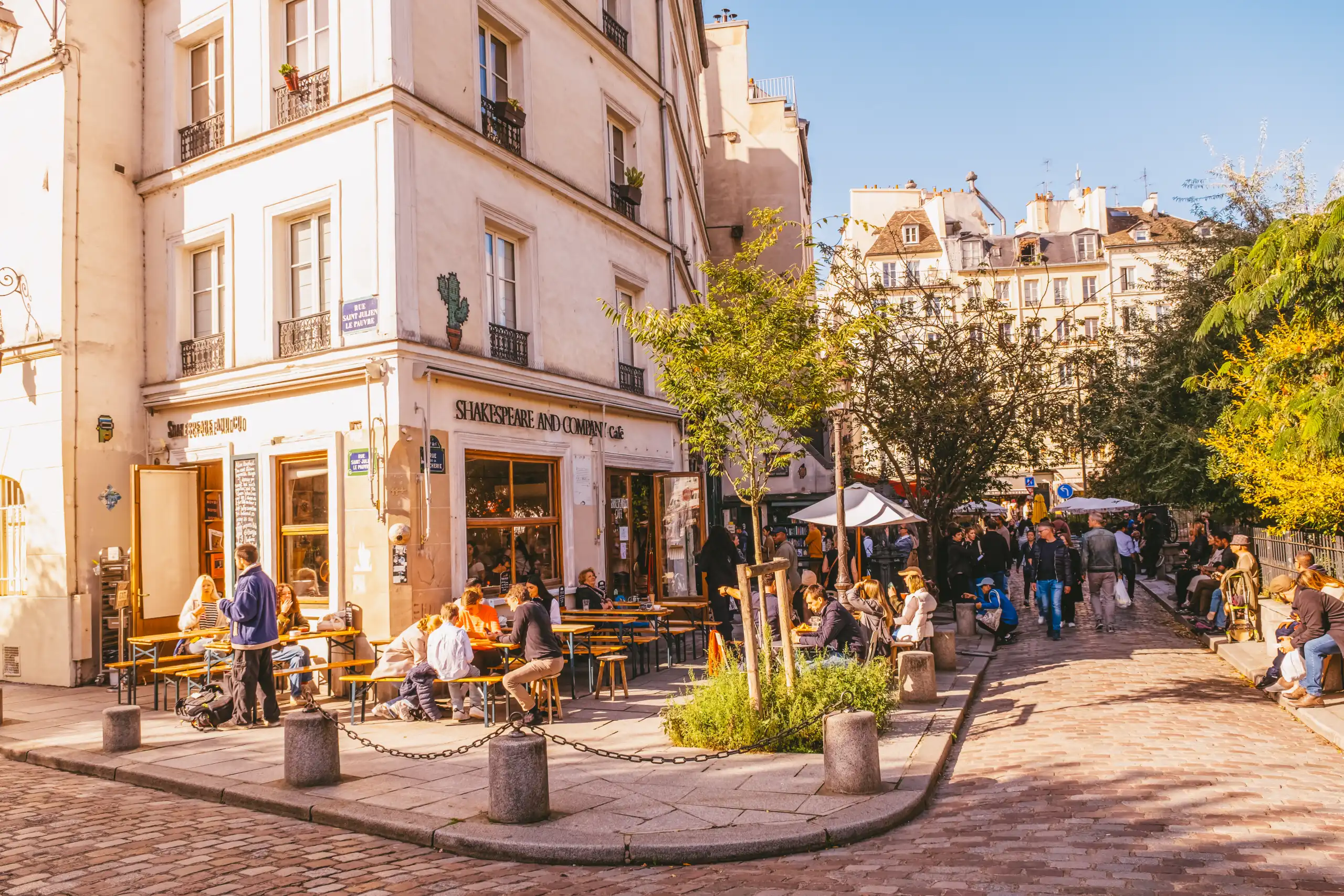
Most visitors experience Paris a week at a time, gravitating toward the 1st arrondissement’s monuments or Montmartre’s cobblestone charm. Buyers face a different reality. Finding the best arrondissement to live in means looking beyond the postcards: the district you choose dictates your daily rhythm—the morning espresso steps away, the weekly market, and how easily the city truly becomes yours.
Many international buyers begin with the same question visitors do—where to stay in Paris—but long-term living demands a different lens. The right arrondissement for a week in the city is not always the right one for daily life, family logistics, retirement or long-term value. This guide looks at the arrondissements through what matters most to buyers: lifestyle, safety, family life, retirement, pied-à-terre use and luxury investment.
How Paris’s arrondissements are organized
Paris’s 20 arrondissements spiral clockwise from the center outward. Price, heritage density and international buyer demand generally decrease as you move outward—although there are important exceptions, and several outer districts have become increasingly attractive to both local and international buyers.
- Central (1st–7th): dense, walkable, historically protected, and among the most sought-after addresses in Europe.
- Mid-ring (8th–12th): business, residential and cultural districts, home to some of the city’s most prestigious addresses in the 8th (Avenue Montaigne) and the 9th (Saint-Georges). The 9th to 12th, always popular with French buyers, are now also sought after by international buyers.
- Outer (13th–20th): more residential and local in character, with less tourist traffic; increasingly popular with younger buyers and investors.
How to choose the right arrondissement
There is no single best arrondissement for everyone. The right choice depends on what you value most: walkability, quiet, schools, museums, green space, investment potential, proximity to healthcare, or the ease of locking up and leaving a pied-à-terre.
For some buyers, centrality is everything. For others, the better long-term decision is more space, fewer tourists and a stronger neighborhood feel. That is why the most useful way to think about Paris is not as a list of “best” districts, but as a set of trade-offs.
Quick guide: which arrondissement is right for you?
| If you are looking for… | Start with |
| Central, classic Paris | 6th and 7th |
| Calm long-term living and retirement | 15th and 16th (and the 7th for its expat community) |
| A family home | 7th, 15th, 16th and 17th |
| Luxury and scarcity | 6th, 7th, 8th and 4th |
| A pied-à-terre | 3rd/4th, 6th and 9th |
| A more local, residential rhythm | 14th, 15th, 16th and 17th |
Safest arrondissements to live in Paris
Crime in Paris concentrates in tourist corridors and transit hubs—not in the residential districts where most international buyers purchase. The French Ministry of the Interior publishes annual crime statistics by arrondissement, and the pattern is consistent. For more detail, see our guide to safety by arrondissement.
- 14th (Montparnasse): the lowest rate of violent theft in the city. Mostly residential, calm and local in character.
- 6th (Saint-Germain-des-Prés): one of the safest central arrondissements. Well-policed, densely residential and well-lit.
- 7th (Eiffel Tower district): home to roughly 30 embassies, with an enhanced security presence.
- 16th (Passy / Auteuil): consistently among the lowest-crime arrondissements. Low density, with a highly private feel.
One area to be aware of: Place de la République, where the 3rd, 10th and 11th arrondissements meet, is a central location for protests because of its large open layout and the Monument de la République, a bronze statue of Marianne representing liberty, equality and fraternity. These features make it a historic gathering site for demonstrations, which buyers looking at apartments on or near the square should keep in mind.
“Crime data in Paris is tracked by arrondissement, but it can vary quite a bit from one quartier to the next within the same district. When we’re advising clients on safety, we’re always looking at the specific blocks—not just the arrondissement number.” — Miranda Junowicz, Founder, Paris Property Group
Best arrondissements for retirees and expats
A growing number of American and British buyers each year choose to retire in France, and Paris remains the center of gravity for most of them. The best district depends on priorities: walkability, healthcare proximity, green space or an expat community.
7th arrondissement
- The strongest concentration of expat families in Paris, particularly around École Militaire.
- Roughly 30 embassies nearby provide strong international infrastructure.
- Walking distance to the Musée d’Orsay, the Rodin Museum, rue Cler and the Seine.
15th arrondissement (Vaugirard / Grenelle)
- Strong expat presence around Grenelle and Convention.
- Multiple metro lines and tramway T3a: well connected without a car.
- More affordable than the 6th or 7th, with meaningfully more space for the same budget.
16th arrondissement (Passy / Auteuil)
- The Bois de Boulogne on the doorstep, the second-largest green space in Paris.
- A long-established British expat community; the Marché de Passy is open six days a week.
- Houses and private mansions are available, which is uncommon elsewhere in Paris.
“The 15th and 16th are genuinely calm—but they’re still Paris. Clients who retire here aren’t giving up the city. They’re just choosing a quieter version of it.” — Jerome Cacarie, Lead Agent, Paris Property Group
Retirees in the 15th benefit from proximity to the Hôpital Européen Georges Pompidou, one of Paris’s largest teaching hospitals. The American Hospital of Paris, in neighboring Neuilly-sur-Seine, is easily reached from the 16th and serves English-speaking patients—a practical consideration for anyone relocating from the US or UK.
Best arrondissements for families
For expat families with school-age children, the arrondissement decision often comes down to proximity to a good international school.
7th arrondissement
- The strongest expat family community in Paris, with multiple bilingual and international schools nearby.
- The Champ de Mars serves as a large neighborhood park; the 7th remains one of the most expensive districts in Paris.
15th arrondissement (Grenelle / Convention)
- ICS Paris, BISP and EIB Grenelle are all located here: three well-regarded international schools in one district.
- Prices are well below the 7th, offering significantly more space for the same budget.
16th arrondissement (Passy / Bois de Boulogne)
- The Bois de Boulogne on the doorstep provides Paris’s second-largest green space.
- Two- and three-bedroom apartments are much more available here than in the central arrondissements.
17th arrondissement (Batignolles / Monceau)
- Parc Monceau is one of Paris’s most character-rich parks; EIB Monceau serves international families.
- Batignolles has a distinctly local, village feel: a quieter, highly desirable entry point into Paris family life.
Best arrondissements for a pied-à-terre
A pied-à-terre is an apartment kept for periodic use by someone whose main home is elsewhere—French for “foot on the ground.” The Paris pied-à-terre market is active among international buyers, and the best district depends on what you are optimizing for. These are a few of the best-known neighborhoods for pied-à-terre buyers:
- Walkability – 3rd/4th (Le Marais): walking distance to galleries, restaurants and transit.
- Neighborhood character – 6th (near the Luxembourg Gardens): quieter than the Marais, with strong long-term price performance.
- Value and rental income – 9th: an active short-term rental market where legally permitted, and excellent metro access.
“The Marais and the 6th are where we see the most activity for pied-à-terre purchases. But a lot of our value comes from helping clients think beyond the neighborhoods they already know—areas with the same feel and walkability, but at a price point that changes the math.” — Jennifer Jomard, Agent, Paris Property Group
A note on renting out a pied-à-terre: Paris is no longer issuing new short-term rental permits; only properties with an existing permit can legally operate as short-term rentals, and fines for illegal rentals reach up to €50,000. Energy ratings matter too: since January 2025, G-rated properties can no longer be rented, and F-rated properties follow in 2028.
If you will spend months rather than weeks in Paris, daily life matters as much as the address. As Miranda puts it in our article on finding your Paris neighborhood for daily life, “We see clients fall in love with the most picturesque spots, but then they realize they’re paying tourist prices for everything from groceries to dry cleaning.”
Top arrondissements for luxury real estate and investment
Paris luxury real estate operates in a constrained market. Heritage preservation rules limit what can be modified in the central arrondissements, and international demand has held steady through recent economic cycles.
- 7th: leads the city in transaction volume for high-value properties. Top-floor apartments with Eiffel Tower views are among the most coveted addresses in Paris.
- 6th (Saint-Germain-des-Prés): renovated apartments near the Luxembourg Gardens regularly trade well above €2 million.
- 8th (Golden Triangle): Avenue Montaigne and George V define the status-address market. Rental yields are modest here, firmly in lifestyle-purchase territory.
- 4th (Île Saint-Louis and the Marais): Île Saint-Louis has one of the most limited inventories in the city, and properties on the Place des Vosges command a significant premium.
Buyers in these districts are generally buying for lifestyle and long-term value rather than income: rental yields in Paris’s most expensive arrondissements tend to be modest.
Is it expensive to live in Paris?
Cost is one of the biggest dividing lines between neighborhoods. Buyers who focus only on the “best” central districts often discover that the real decision is about trade-offs: charm versus square footage, prestige versus practicality, and walkability versus value.
In general, the 6th, 7th and 8th command some of the highest prices in the city, while the 15th, 16th and 17th often offer more space and a calmer residential feel for the same budget. For some long-term buyers, that trade-off is exactly what makes these outer prime districts more compelling than the postcard center.
The 9th to 12th offer another route: always popular with French buyers and now increasingly with international ones, they combine strong neighborhood life with prices below the central districts.
Frequently asked questions
What is the best arrondissement to live in Paris?
- There is no single answer. For central, classic Paris, buyers start with the 6th and 7th; for families, the 7th, 15th, 16th and 17th; for calm long-term living and retirement, the 15th and 16th; and for a pied-à-terre, the 3rd/4th, 6th and 9th.
What is the safest arrondissement in Paris?
- The 14th has the lowest rate of violent theft in the city, and the 6th, 7th and 16th are consistently among the safest. Crime concentrates in tourist corridors and transit hubs rather than residential districts, and it varies from block to block within an arrondissement.
Which arrondissement is best for families?
- The 7th has the strongest expat family community, the 15th has three international schools and prices well below the 7th, the 16th has the Bois de Boulogne and larger apartments, and the 17th offers Parc Monceau and Batignolles’ village feel.
Where do expats and retirees live in Paris?
- Many settle in the 7th, 15th and 16th, which combine established expat communities, green space, good transport and access to hospitals, including the American Hospital of Paris near the 16th.
Finding the right arrondissement for you
The arrondissement question doesn’t have a universal answer. It has the right answer for your budget, your schedule, your family’s priorities and how you plan to use the property. Getting there takes more than a map—it takes an expert understanding of how each district actually functions for the people who live in it for all or part of the year.
At Paris Property Group, we start by understanding what matters most to you in a location: how you will use the apartment, how you like to spend your days, and what you can and cannot compromise on. From there, we often introduce clients to neighborhoods they had not considered, with the same feel and walkability as the areas they already know, but a better fit for how they want to live.
Learn more about our buyer services, or contact Paris Property Group to talk through where you might buy.
Social Cookies
Social Cookies are used to enable you to share pages and content you find interesting throughout the website through third-party social networking or other websites (including, potentially for advertising purposes related to social networking).