

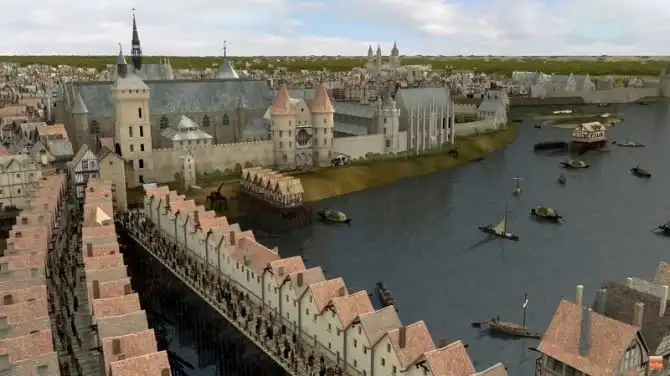
Have you ever wondered how the City of Light appeared before the grand boulevards and uniform facades? While the 16th century laid the groundwork, taking a virtual walk through Paris in the 1600s reveals a city on the cusp of a massive transformation. Thanks to 3D maps developed by Grez Productions, we can now navigate the narrow, winding veins of a metropolis that was both a medieval relic and a rising global capital.
The Real Estate Landscape of Paris in the 1600s
Chances are you might recognize some of the landmarks from 1550 and the early 17th century. The Cathedral of Notre-Dame had already stood for centuries, though it was draped in vibrant, multi-colored tones quite different from the weathered stone we see today. The Abbey of Saint-Germain-des-Prés dominated the Left Bank, though much of its expansive grounds have since been reclaimed by the city’s growth.
Paris in the 1600s was a study in density. It was cramped, noisy, and lived-in, yet it remained the undisputed beating heart of France. To find the spacious boulevards and Haussmannian buildings that define modern Paris real estate, one would have to wait nearly 250 years. Instead, the 17th-century buyer would have found a city of hôtels particuliers (grand private mansions) beginning to bloom in the Paris Marais neighborhood, hidden behind high stone walls and heavy timber doors.
Bridges as Prime Property
One of the most striking features of this era was the use of bridges as commercial and residential hubs. The Pont au Change and the Pont aux Meuniers were not merely transit points; they were lined with “serried ranks” of buildings.
Owing to high foot traffic, these bridges were the most coveted retail locations in Europe—a concept mirrored by the original London Bridge and the Ponte Vecchio in Florence, which is still host to jewelers and art dealers. Today, these “bridge-houses” are long gone, replaced by the open vistas of the Seine that we consider a hallmark of Parisian luxury.
Did You Know?
The Secret of the “Half-Timber” Ban While we associate the 1600s with charming colombage (half-timbered) houses, they were actually a major fire hazard. In an early form of “zoning laws,” authorities eventually mandated that timber frames be covered in plaster to prevent the spread of fire. This transition is why many historic buildings in the Marais look like solid stone but actually have “skeletons” of ancient oak hidden beneath their skin!
Looking to Own a Piece of History?
The transition from the medieval fortress-style of the 1600s to the luxury apartments of today is what makes the Parisian market so unique. Whether you are interested in who owns Paris real estate today or you are drawn to the exposed beams of a 17th-century attic, the city’s architectural layers offer unmatched value. Even individual artifacts, like Eiffel Tower steps, carry the weight of this incredible history.
Contact Paris Property Group to learn more about buying or selling property in these historic neighborhoods.
Social Cookies
Social Cookies are used to enable you to share pages and content you find interesting throughout the website through third-party social networking or other websites (including, potentially for advertising purposes related to social networking).