

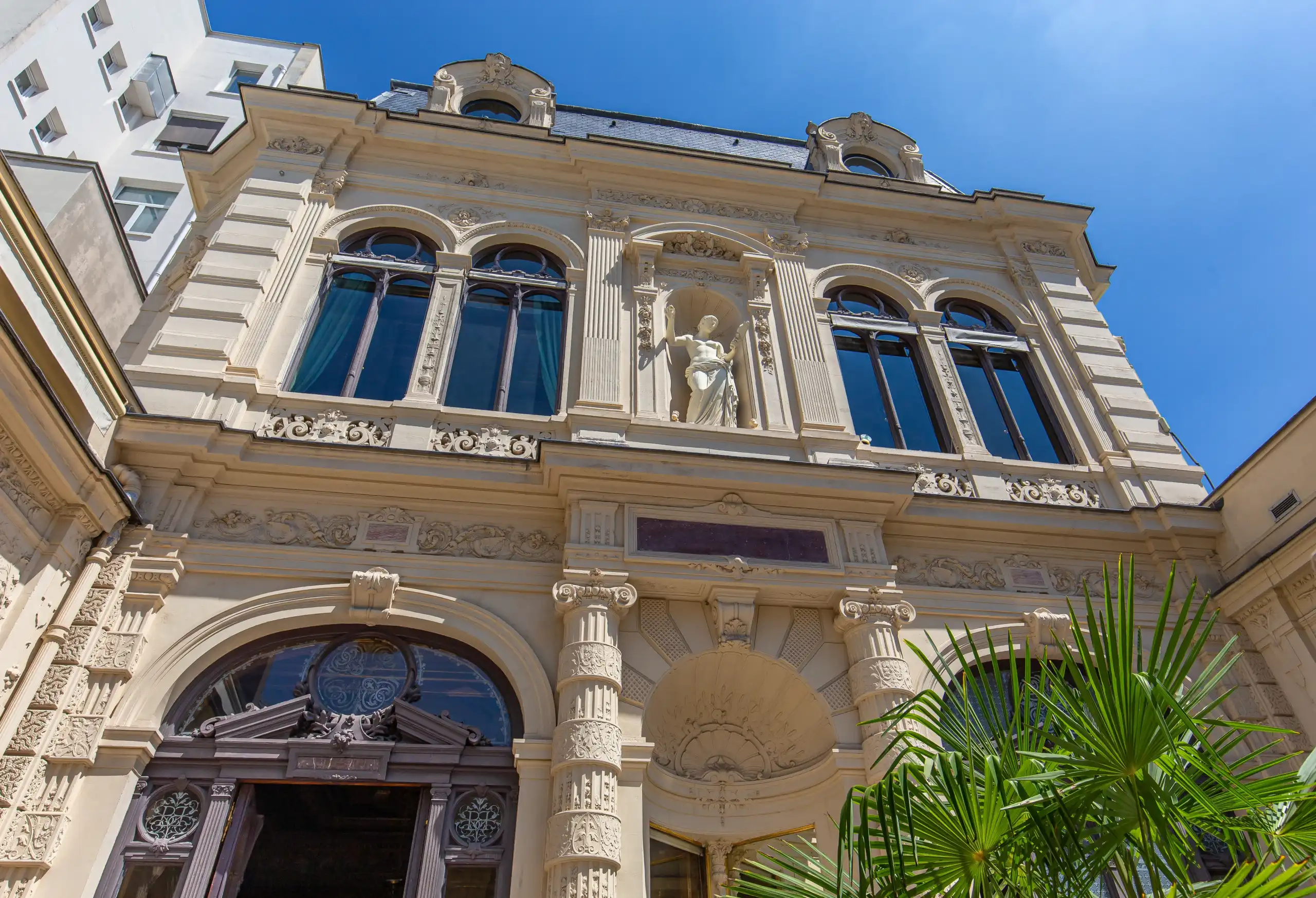
A recent front-page spread in Le Grand Parisien put a number on what many observers of the Paris luxury market already suspected: the city’s hôtels particuliers are now trading at prices that reach €80,000 per square meter in the most coveted addresses. For context, the median price per square meter for a Parisian apartment in a prime arrondissement runs between €12,000 and €17,000. What is driving this gap, who is buying these properties, and what does the process actually look like for an international buyer?
What Is an Hôtel Particulier?
The term does not refer to a hotel in any modern sense. An hôtel particulier (literally “private mansion”) is a freestanding urban residence built for a single owner, typically dating from the 17th or 18th century. Unlike Haussmann-era apartment buildings, which share party walls and open directly onto the street, these structures are set back from the road behind a formal entrance courtyard — the cour d’honneur — with a private garden at the rear. The layout has remained largely unchanged for centuries:
- Reception rooms on the ground floor
- Private apartments on the first floor (piano nobile)
- Guest and children’s quarters above
- Staff quarters in the basement or attic
There are an estimated 400 to 500 of these properties still standing within Paris proper, concentrated in the 7th, 8th, 16th, and Marais arrondissements. Many carry listed monument status, which restricts exterior modifications but does not prevent sale or private ownership.
How Rare Is “Rare”?
Transactions in this segment are genuinely uncommon. Because sales are not required to be publicly announced, no comprehensive market registry exists. Analysts describe the market as opaque by nature: deals are negotiated privately, buyers are often institutional or family-wealth structures, and disclosed pricing is the exception rather than the rule.
The benchmark transaction most frequently cited is the 2022 sale of the Hôtel Lambert on the Île Saint-Louis — a 17th-century property built by Louis Le Vau, the same architect responsible for Versailles — which sold for more than €200 million to telecom entrepreneur Xavier Niel, establishing what Bloomberg described as one of the largest private property deals in the city’s history. The previous record holder, the Hôtel de Soyecourt, had sold for €100 million in 2011. The doubling of that figure in roughly a decade reflects how sharply demand has outpaced supply at the top of the market.
French trade press reported three separate hôtel particulier transactions in the 7th arrondissement during 2025, totaling more than €200 million combined. That kind of activity, concentrated in a single arrondissement within a single year, signals sustained demand in a segment where available properties are structurally fixed in number.
Who Is Buying These Properties?
The buyer pool is narrow and international. In the luxury real estate market in Paris, properties above €2 million, international buyers represent a meaningful share of transactions, with active demand from North America, the Gulf states, and Europe. At the hôtel particulier level specifically, buyers tend to fall into a few categories:
- French and international business families consolidating multi-generational wealth
- Family offices and private foundations seeking a long-term patrimony asset
- Diplomatic and cultural institutions requiring a prestigious Paris address
- High-net-worth individuals using the property as a primary residence
A luxury real estate market analysis published in April 2026 noted that after roughly two years of price correction in Paris’s broader residential market, the prestige segment — properties above €2 million — had already returned to growth, with the 7th and 8th arrondissements posting the strongest performance. The report also observed that, unlike in prior cycles, buyers in 2026 are no longer deterred by properties requiring heavy renovation, provided the address is strong.
What Does It Cost to Own One, Beyond the Purchase Price?
The carrying costs of a Parisian property are relatively modest compared with equivalent properties in London or New York. But at the scale of an hôtel particulier, several additional considerations apply.
Standard annual ownership costs for any Paris property include:
- Taxe foncière (property tax): approximately 0.1% to 0.2% of purchase price per year
- Homeowner insurance: typically €500 to €600 annually for a standard apartment; substantially more for a large freestanding property
- Building and maintenance fees: hôtels particuliers are individually owned, so there is no co-ownership structure — maintenance of the structure, garden, and systems falls entirely to the owner
Owners of real estate assets exceeding €1.3 million in net taxable value in France are also subject to the annual Impôt sur la Fortune Immobilière (IFI), the French real estate wealth tax. Rates are graduated from 0.5% on the portion between €800,000 and €1.3 million, up to 1.5% on assets above €10 million. For a property valued at, say, €15 million, the annual IFI liability can be significant — though financing the purchase reduces the taxable base, since outstanding mortgage debt is deductible.
Is the Purchase Process the Same as for an Apartment?
In its legal framework, yes. All French real estate transfer typically follows the same two-stage process: a preliminary contract (promesse de vente or compromis de vente) followed by the final deed (acte de vente), both handled by a notaire. Buyers have a 10-day reflection period after signing the preliminary contract, during which they may withdraw without penalty. A good-faith deposit, typically 10%, but sometimes less at the higher price points, of the purchase price is held in the notaire’s escrow account.
Closing costs for the buyer — covering land registry taxes, notaire fees, and miscellaneous registration expenses — run approximately 7.5% of the purchase price regardless of the property type.
In practice, however, hôtel particulier transactions involve several layers of complexity not typically present in standard apartment sales:
- Monument historique status: If the property is listed, any exterior modification requires approval from the Architectes des Bâtiments de France. This affects renovation timelines and costs but can also provide significant tax incentives for restoration work.
- Ownership structuring: At this price level, buyers almost always engage both a notaire and an independent tax attorney before signing anything. The choice between individual ownership, SCI (Société Civile Immobilière), or another structure has long-term consequences for inheritance and tax.
- Discretion and off-market access: The majority of hôtel particulier sales never appear in public listings. Sellers at this level typically prefer a controlled process involving a small number of pre-qualified buyers.
Are These Properties a Sound Investment?
The honest answer is that returns depend almost entirely on the buyer’s objectives. Hôtels particuliers do not generate income in the way a rental apartment does — they are rarely subdivided or rented commercially, and many listed properties have restrictions on commercial use. Their value proposition is preservation of capital in an asset class that is, by definition, non-reproducible.
The data supports that argument. Paris intra-muros — the city proper, within its périphérique ring road — covers just 105 square kilometers with no new buildable land. The number of hôtels particuliers is effectively fixed — there will not be more of them. In markets where demand from wealthy international buyers continues to grow and supply is structurally constrained, that combination has historically supported prices even through broader market corrections.
Whether that dynamic holds at €80,000 per square meter is a question that only future sales will answer.
Contact Paris Property Group to learn more about buying or selling property in Paris.
Social Cookies
Social Cookies are used to enable you to share pages and content you find interesting throughout the website through third-party social networking or other websites (including, potentially for advertising purposes related to social networking).