

The Architectural Legacy and History of the Grands Magasins Paris
Since their creation, Parisian department stores have always been at the forefront of progress and innovation in the capital, benefiting from 19th-century technological evolutions as well as the widening of Paris’ boulevards under Baron Haussmann. Although les grands magasins are an integral part of the city’s celebrated heritage, many are unaware of the humble beginnings that gave rise to these imposing establishments.
Read on to uncover the history behind the four major grands magasins Paris and how they transformed the Paris real estate landscape: Le Bon Marché, le BHV Marais, Printemps Haussmann, and Galeries Lafayette Haussmann.
Le Bon Marché: The Left Bank Pioneer
The oldest Parisian department store, Le Bon Marché was initially created in 1838. Located in the sophisticated 7th Arrondissement, it began when Paul and Justin Videau opened a shop where customers could find various household items and sewing tools. However, it was Aristide Boucicaut who made the store what it is today.
In 1853, he joined forces with the Videau brothers and decided to create a department store designed with a female clientele in mind. Over the years, Le Bon Marché introduced and popularized concepts that defined modern retail: satisfaction guarantees, fitting rooms, and of course les soldes—the infamous bi-annual sales throughout France. The store’s revolutionary glass-and-iron architecture even inspired Émile Zola’s 1883 novel Au Bonheur des Dames.
Le BHV Marais: A Reward for Heroism
Le Bazar de l’Hôtel de Ville was created in 1852 by Lyonnais shop-keeper Xavier Ruel. While many look to buy an apartment in the Marais for its medieval charm, the BHV owes its true success to a 19th-century turn of events.
Legend has it that in 1855, Empress Eugénie, wife of Napoleon III, was passing by the store with her horses when they suddenly spooked. Xavier Ruel succeeded in calming the horses and restoring order. The Empress rewarded Ruel for his service with a significant sum of money, which he immediately invested in the expansion of his shop. Later, in the first half of the 20th century, Ruel’s grandson took over, cementing its place as the commercial heart of the 4th Arrondissement.
The Golden Age of Grands Magasins Paris: Printemps Haussmann
While there are several Printemps locations, the Boulevard Haussmann flagship is the most legendary. Opened in 1865, it was a bold gamble; at the time, the 8th Arrondissement was still undergoing massive transformation.
This didn’t stop entrepreneurs Jules Jaluzot and Jean-Alfred Duclos from specializing in luxury fabrics. As the “Haussmannization” of Paris continued, the store expanded into one of the most elegant structures in the capital. Its breathtaking facade and innovative use of electricity led to it being classified as a historical monument in 1975. Today, the surrounding Right Bank area remains some of the most sought-after commercial and residential real estate in the world.
Les Galeries Lafayette Haussmann: The Art Nouveau Masterpiece
Neighboring Printemps, Galeries Lafayette was created in 1894 when Alphonse Kahn and his cousin Théophile Bader took over a retail business at 1 rue Lafayette. As the neighborhood became the commercial heartbeat of Paris, the store expanded along the boulevard.
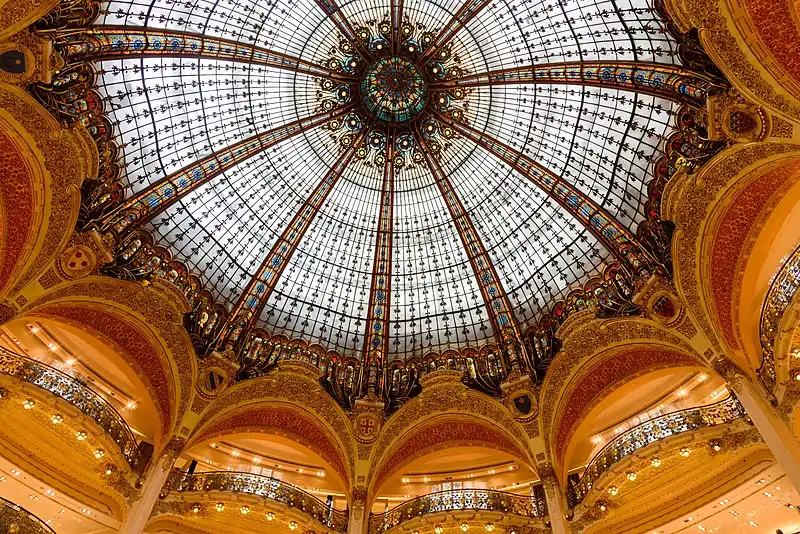
The store’s celebrated 43-meter-high dome ceiling—a masterpiece of glass and steel—was completed in 1912. Today, Galeries Lafayette Haussmann is the most-visited of all the grands magasins Paris, attracting curious visitors as much as shoppers. From the Art Nouveau dome to the rooftop terrace offering spectacular views of the Opéra Garnier, it represents the pinnacle of Belle Époque architecture.
Did You Know?
The “Cathedrals of Commerce” The construction of these grands magasins relied on the same engineering brilliance as the Eiffel Tower. Many of these buildings used internal iron frameworks designed by Gustave Eiffel’s contemporaries to create the wide, open floor plans and soaring glass ceilings. This allowed natural light to flood the sales floors at a time when indoor lighting was still primitive, forever changing the architectural style of commercial Paris.
For more about what’s ahead for Paris’ grands magasins, check out the New York Times article that quotes Paris Property Group’s Kathryn Brown.
Contact Paris Property Group to learn more about buying or selling property in Paris.
Social Cookies
Social Cookies are used to enable you to share pages and content you find interesting throughout the website through third-party social networking or other websites (including, potentially for advertising purposes related to social networking).