

The Details That Matter: Understanding Cornice, Moulures, Rosaces, Boiserie, and More
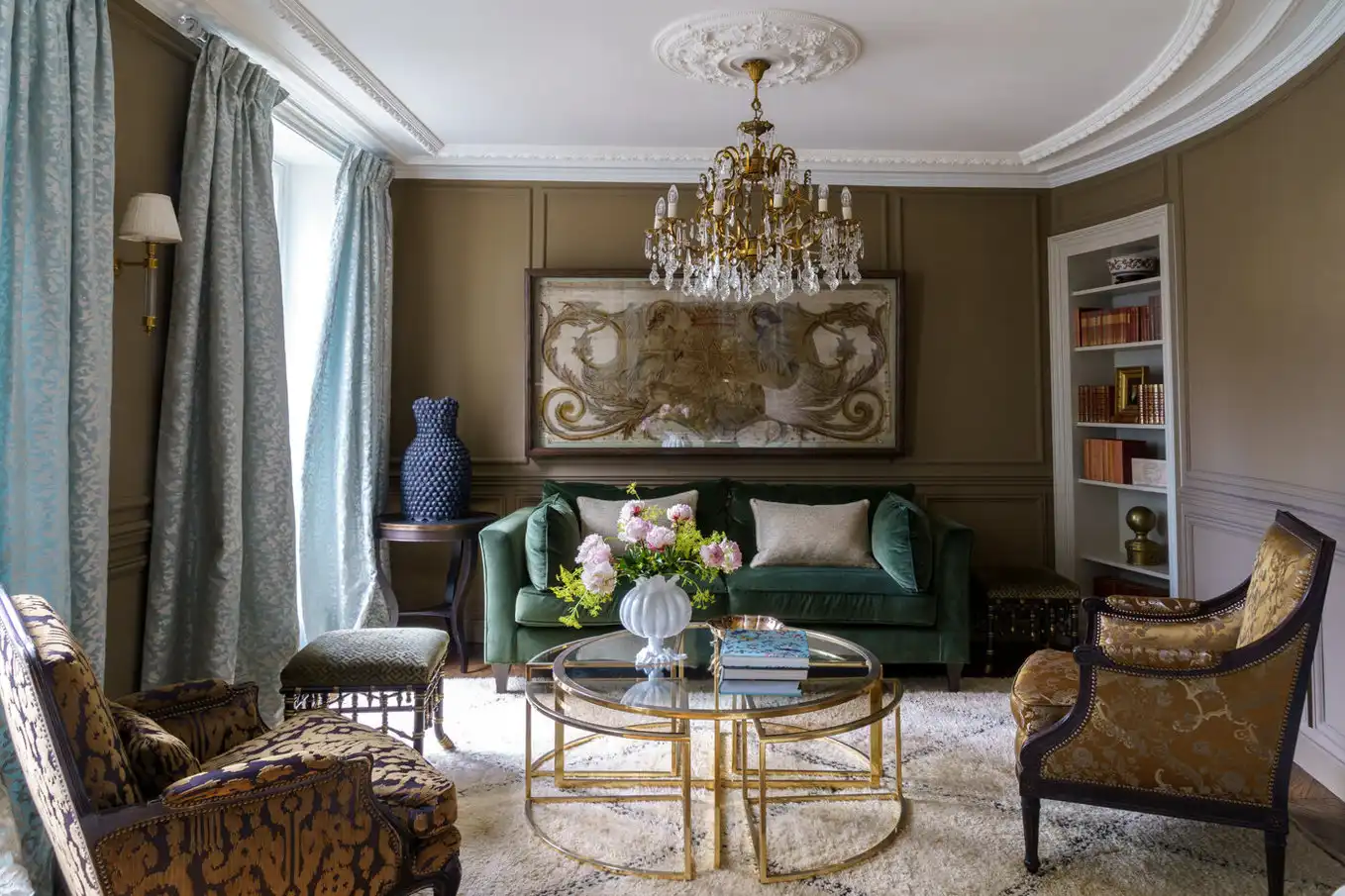
Walking through a classic Parisian apartment feels like stepping into a living museum. Above you, elaborate cornices frame the ceiling like frozen lace. Plaster medallions bloom overhead, their intricate florals casting delicate shadows. Wooden boiserie panels line the walls with geometric precision, while at your feet, carved plinthes anchor the room’s proportions. These architectural details—corniche, moulures, rosaces, boiserie, and more—tell the story of Paris itself, marking the passage of centuries through plaster and wood.
When Did Paris Become Paris?
The decorative elements of Parisian apartments emerged during distinct historical periods, each leaving its signature in plaster and wood. The 17th century introduced grand boiserie—those floor-to-ceiling wood panels that transformed walls into geometric art. Louis XIV’s Versailles established the template: carved oak or walnut panels painted in soft grays, creams, or left natural, creating rhythm and warmth while concealing irregular masonry beneath.
The 18th century brought lighter, more playful designs. Rococo style introduced asymmetrical curves, shell motifs, and delicate floral patterns. Cornices—the decorative moldings where walls meet ceilings—became more elaborate, featuring egg-and-dart patterns, acanthus leaves, and running vines. Ceiling rosaces or medallions expanded in complexity, radiating from central light fixtures like frozen fireworks. These weren’t mere decoration; they served the practical purpose of reinforcing ceiling structures around heavy chandeliers while adding visual grandeur.
The Haussmannian era of the mid-to-late 19th century standardized these elements across Paris. Baron Haussmann’s massive urban renewal project created the Paris we recognize today, complete with consistent architectural vocabulary. Apartments from this period feature high ceilings framed by substantial cornices, often 15 to 20 centimeters deep. Ceiling medallions became more restrained but remained ubiquitous. Moulures—the decorative moldings around doors, windows, and along walls—created visual harmony throughout rooms.
What Exactly Are We Looking At?
Understanding these elements requires knowing their names and functions. Cornice refers to the crown molding at the ceiling line, often featuring multiple bands of geometric or naturalistic patterns. Moulures encompass all decorative moldings, from simple door casings to elaborate wall panels. Rosaces or médaillons are the circular or oval ceiling centerpieces, ranging from simple concentric rings to elaborate compositions featuring human faces, mythological scenes, or botanical abundance.
Boiserie specifically describes wood paneling, whether simple rectangular frames or elaborate carved compositions. Plinthes are the baseboards where walls meet floors, typically taller in period apartments than modern construction—often 15 to 20 centimeters high, sometimes carved or profiled. Cimaises are the chair-rail height moldings that protected walls from furniture damage while creating visual proportion. Trumeaux are the decorative panels above doorways or between windows.
“When clients ask us to evaluate properties, we always look carefully at the condition of these details,” notes Paris Property Group founder Miranda Junowicz. “Original cornices and medallions in good condition add value. But poorly executed restorations or inappropriate additions can work against you. The market recognizes the difference between authentic period work and cosmetic fixes.”
How Do Modern Artisans Preserve the Past?
Restoring or recreating these architectural elements requires specialized craftspeople who’ve mastered techniques largely unchanged since the 19th century. Plasterwork artisans, or staffeurs-ornementalistes, create cornices and medallions using traditional methods. They build up layers of plaster over wooden or metal armatures, carving details by hand or pressing wet plaster into historic molds. For ceiling rosaces, artisans often work from catalogs of period designs, selecting patterns appropriate to a building’s construction date.
The process begins with careful examination. In apartments where original details survive beneath layers of paint, artisans gently remove overpainting to reveal the original work. Where elements are damaged, they create silicone molds from intact sections to reproduce missing pieces. For entirely missing cornices, they reference period architectural guides and neighboring apartments to ensure historically accurate replacements.
Wood restoration presents different challenges. Original boiserie was typically oak, walnut, or pine, often painted in period colors or faux-finished to resemble expensive materials. Restorers must address centuries of wear, paint layers, and sometimes structural damage. The work involves careful stripping, repair of carved details using matching wood, and refinishing with historically appropriate techniques. Some artisans specialize in creating new boiserie for modern installations, milling profiles that match period examples.
Should You Add What Wasn’t There?
Contemporary renovations raise authentic questions about adding period details to apartments that never had them. Some buildings, particularly workers’ housing from the Haussmannian era, were built with minimal ornamentation. Later 1920s and 1930s buildings often featured simplified Art Deco details rather than classical ornament. Adding elaborate Haussmannian details to these spaces creates historical fiction.
Yet the market often rewards period details regardless of authenticity. Apartments with restored or added cornices, medallions, and moldings command premiums over stripped-down spaces. For international buyers particularly, these elements signal “authentic Paris” regardless of whether they were original to the specific apartment.
The cost of adding these details varies considerably. A simple cornice installation might cost 80 to 120 euros per linear meter. Elaborate ceiling medallions range from 300 euros for simple reproductions to several thousand for custom work. Complete boiserie installations can reach 1,500 to 3,000 euros per square meter depending on complexity and wood quality. Restoration of existing elements typically costs less than creation, though severely damaged work can prove more expensive to repair than replace.
What Does the Future Hold?
These architectural elements continue evolving. Contemporary Parisian renovations increasingly blend period details with modern aesthetics—preserving original cornices and medallions while introducing clean-lined furniture and contemporary materials. Some architects advocate for honest renovation that distinguishes new work from old, using simplified molding profiles or contemporary interpretations of classical forms.
The craft traditions themselves face uncertainty. Fewer young people train as staffeurs-ornementalistes or menuisiers specializing in period woodwork. The knowledge required to accurately reproduce historical details depends on master craftspeople passing skills to apprentices, a transmission threatened by economic pressures and changing construction practices. Yet demand from renovation projects continues supporting specialist workshops across Paris and surrounding regions.
Walking through a Parisian apartment, running your hand along a carved plinth or gazing up at an elaborate ceiling rosace, you’re touching continuity. These details connect us to the craftspeople who shaped them, the residents who lived among them, and the city’s accumulated layers of beauty and function. They remind us that architecture isn’t just about shelter—it’s about creating spaces that acknowledge our human need for pattern, proportion, and ornament. In Paris, that acknowledgment is written in plaster and wood throughout the city.
Contact Paris Property Group to learn more about buying or selling property in Paris or to be introduced to a trusted mortgage professional.
Photo courtesy of MLR Design Studio.
Social Cookies
Social Cookies are used to enable you to share pages and content you find interesting throughout the website through third-party social networking or other websites (including, potentially for advertising purposes related to social networking).