

The Living History of the Oldest Buildings in Paris: A Millennium of Architecture
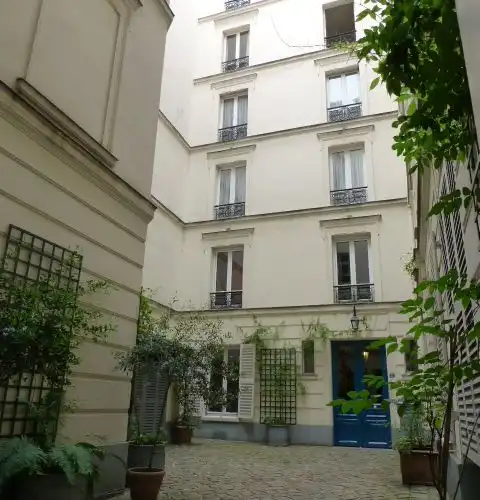
Paris, France, is an unusually coherent architectural creature. The city’s modern structures have developed gradually out of earlier styles; palaces and mansions have survived by transforming into apartments and shops, and most streets harbor a range of buildings from various centuries. Our guide traces a millennium of construction, and what’s amazing is that so much remains visible and integrally important to the way that Paris works, from the earliest Medieval period through the most contemporary designs.
Paris evolved out of a walled city, and some historians argue that this alone has given the capital a certain logic that London or Boston lacks. Paris has really never lost its walls: 900 years after the 12th-century wall of Philippe Auguste, we now live in a city enclosed by its ring-road, the Périphérique highway. This succession of walls, gradually torn down and rebuilt through the centuries, has created a spiraling city which grew outward from the Île de la Cité. It’s not surprising that many of the oldest buildings in Paris are found near the center of this historical spiral.
The Medieval Period (1100–1526): Scouting the Oldest Buildings in Paris
In 52 BC, the Romans defeated a tribe called the Parisii and established a city they named Lutetia, which probably means “swampy.” Today, that city is Paris—and it’s still swampy in the springtime! Traces of Roman architecture remain visible: if you look at a map, Rue Saint-Jacques cuts right through the middle of the city and was the main Roman road. But when the Roman Empire crumbled, its architectural genius disappeared, and the Dark Ages were actually a step backward. During the early Middle Ages, Parisians sometimes relocated entire sections of Roman walls to use for their own buildings because the Roman masonry was so much sturdier.
Most surviving medieval architecture in France is religious, largely due to durability. Early secular buildings were often built with flammable wood, whereas churches were made to last with stone. Be sure to visit the Saint-Germain-des-Prés Church, one of the few remaining sites that has retained its 10th-century Romanesque shape.
By the 1100s, three engineering improvements created the Gothic style:
- Pointed arches: Capable of carrying more weight than round arches.
- Cross vaults: X-shaped ribbing for better internal support.
- Flying buttresses: Channeling weight to the ground, allowing for thinner walls and massive stained-glass windows.
The Basilique Saint-Denis (1140–1144) was the first of the great Gothic Cathedrals; here in Paris, Notre Dame, begun in 1163, was the first to appear. Soon after, Paris suffered disasters including constant warfare, the “miniature Ice Age” of 1315, and the Black Death in 1348. This desperation shows in the surviving secular architecture of the time: small windows, heavy shutters, and well-bolted doors protecting inner courtyards.
Did You Know?
The house at 51 rue de Montmorency (3rd Arrondissement) is widely considered the oldest private house in Paris. Built in 1407 by the famous alchemist Nicolas Flamel, it was originally designed to provide housing for the poor. Look closely at the facade: the pillars are carved with figures and inscriptions—a rare, tangible link to the city’s 15th-century real estate.
The Renaissance (1515–1643)
In 1515, Francis I took the throne, surrounding himself with minds like Leonardo da Vinci. He hired Italian architects to renovate the Louvre, bringing the Renaissance to Paris with a bang. Renaissance ideas insisted on human proportion; buildings were read as metaphors for the human shape: the solid base (the foot), the elegant middle (the body), and the peaked roof with gabled windows (the hat).
After the wars of religion, Henri IV restored the city’s brilliance, completing the Pont Neuf and developing the Place Royale (now Place des Vosges) in the 4th Arrondissement. Private real estate flourished under Louis le Barbier, the original French developer, who established neighborhoods like the Faubourg Saint-Germain by constructing “hôtels”—magnificent private urban chateaux—to sell to the nobility.
French Baroque and Classicism (17th Century)
Under Louis XIV, the “Sun King,” the Baroque style reached its peak. While the King preferred Versailles, his minister Colbert commissioned Parisian buildings inspired by Rome to reflect the Empire’s might. This era gave us the Hôtel des Invalides (1671) and a quintessential French invention: the Mansard roof, a double-sloped roofline created by François Mansart that allows for habitable attic space—a feature still highly prized in Paris real estate today.
Rococo to Neo-Classicism (18th – Early 19th Century)
As the Enlightenment dawned, the nature-inspired curves of Rococo became popular (seen in the Hôtel de Matignon). However, the pendulum eventually swung back to the severe symmetry of Neo-classicism. This style—inspired by ancient Greece and Rome—survived the Revolution and was embraced by Napoleon, who wanted Paris to look like the seat of a new Roman Empire. He introduced practical real estate concepts we take for granted, such as numbering streets with odd numbers on one side and even on the other.
The Haussmann Revolutions (1840–1900)
Under Napoleon III, Baron Haussmann radically reorganized Paris. He transformed a cramped, unsanitary medieval city into a modern metropolis of wide boulevards and uniform limestone apartment blocks. Haussmann’s apartment buildings remain the “gold standard” for Parisian living, defining the city’s aesthetic and real estate market for over 150 years.
Art Nouveau to the Modern Movement (1900–1939)
Art Nouveau introduced the “cigarette smoke” curves of Hector Guimard’s Métro entrances. This gave way to Art Deco (or Jazz Moderne) after WWI, characterized by angular shapes reminiscent of ocean liners. During this boom, the “red belt” of brick housing projects was built along the city’s edges where the old city walls once stood.
Post-War to Contemporary (1980–Present)
While the post-war era saw the controversial destruction of Les Halles, it also gave us the Centre Pompidou, which pushed utilities to the exterior to maximize interior space. In the 1980s, President Mitterrand’s “Grands Travaux” introduced the Louvre Pyramid and the Bibliothèque François-Mitterrand, cementing Paris as a leader in contemporary global architecture.
From Paris Notes
By Lisa Pasold
Contact Paris Property Group to learn more about buying or selling property in Paris.
Social Cookies
Social Cookies are used to enable you to share pages and content you find interesting throughout the website through third-party social networking or other websites (including, potentially for advertising purposes related to social networking).