

Medium Term Rentals in Paris: What Owners and Buyers Need to Know

Somewhere between a hotel and a lease, a legal framework most international buyers never fully map out — until now.
April 2026
Paris’s rental market has a layer that most international buyers underestimate: the medium-term furnished rental. It sits between the nightly Airbnb booking and the multi-year primary-residence lease — and it most closely matches how American buyers actually use their Paris properties: spending weeks or months there themselves, then renting in their absence.
Two legal frameworks govern this space — the bail code civil and the bail mobilité — and they are not interchangeable. Understanding which applies to your situation, and why the distinction matters financially, is the starting point for managing a Paris property well. Search data often surfaces the term “mid term rentals” alongside “medium term rentals”; both describe the same category of furnished residential stays running from one month to roughly one year.
What Counts as a Medium-Term Rental in Paris?
There is no single French legal category called “medium-term rental.” In practice, the term describes furnished stays that fall between short-term tourist accommodation and a long-term primary-residence lease. Two distinct legal frameworks cover this range.
The bail code civil is governed by the French Civil Code. It applies when the property serves as the tenant’s secondary residence — a pied-à-terre, corporate housing, or temporary base for someone whose primary home is elsewhere. Duration, rent, and terms are freely negotiated.
The bail mobilité, introduced in 2018, was designed for tenants in specifically defined temporary situations: students, interns, and professionals on a formal work assignment in France. It is capped at ten months, cannot be renewed with the same tenant, and requires qualifying documentation at signing.
For most buyers of Paris property as a secondary residence, one is clearly the better fit.
Who Uses Medium-Term Rentals?
Demand for furnished medium term rentals in Paris consistently outpaces supply in the central arrondissements. The tenant pool includes corporate transferees relocated to Paris for three to nine months; executives on sabbatical or consulting engagements; graduate students and post-doctoral researchers at French institutions; diplomatic and embassy staff; and families evaluating the city before committing to a purchase; and retirees looking to spend time in Paris. In nearly all cases, the tenant already has a primary residence somewhere else — which is precisely the foundation of the bail civil.
Why Medium-Term Rentals Matter for Non-Resident Owners
For non-residents who own a Paris apartment as a secondary residence, short-term rental was never freely available in the first place. Unlike primary residence owners — who could historically rent their home for a limited number of days per year on platforms like Airbnb — owners of secondary residences in Paris have faced a much steeper path. To legally offer a second home as a tourist rental, an owner must first obtain a change-of-use authorization from Paris City Hall, reclassifying the property from residential to commercial use. Paris then requires compensation: for every square meter converted to tourist rental, the owner must convert an equivalent square meter of commercial space into residential use — and in some arrondissements, that ratio doubles to two square meters of commercial for every one residential. Only after both steps are satisfied can the owner obtain the registration number required to list the property legally. The cost and complexity of this process has always made it prohibitive for most individual property owners, and the city has effectively stopped approving new applications.
Enforcement of illegal short term rentals is actively escalating. In February 2026, two Paris property owners who failed to register their Airbnb listings were fined €80,000 and €150,000 respectively, and France’s supreme court ruled that platforms bear legal responsibility for non-compliant listings. The city estimates roughly 25,000 fraudulent advertisements remain active, with fines for serious violations now reaching €100,000 per offense.
Will Displaced Short-Term Operators Flood the Medium-Term Market?
It is a fair question. Some displacement will happen, but the competitive impact on well-positioned owners is likely limited. The properties being pushed out are largely run by professional multi-listing operators, not owners of quality furnished pieds-à-terre. Many will exit or sell rather than rebuild around medium-term rates. Where new medium-term supply does appear, it will likely be at the lower end: smaller studios in outer arrondissements, not competing for the same tenant as a well-maintained Haussmann apartment managed by an experienced rental manager.
Bail Civil vs. Bail Mobilité: Which Lease Fits Your Property?
For the vast majority of American buyers purchasing in Paris, the property is a secondary residence by definition. That makes the bail civil the natural — and in most cases the superior — instrument.
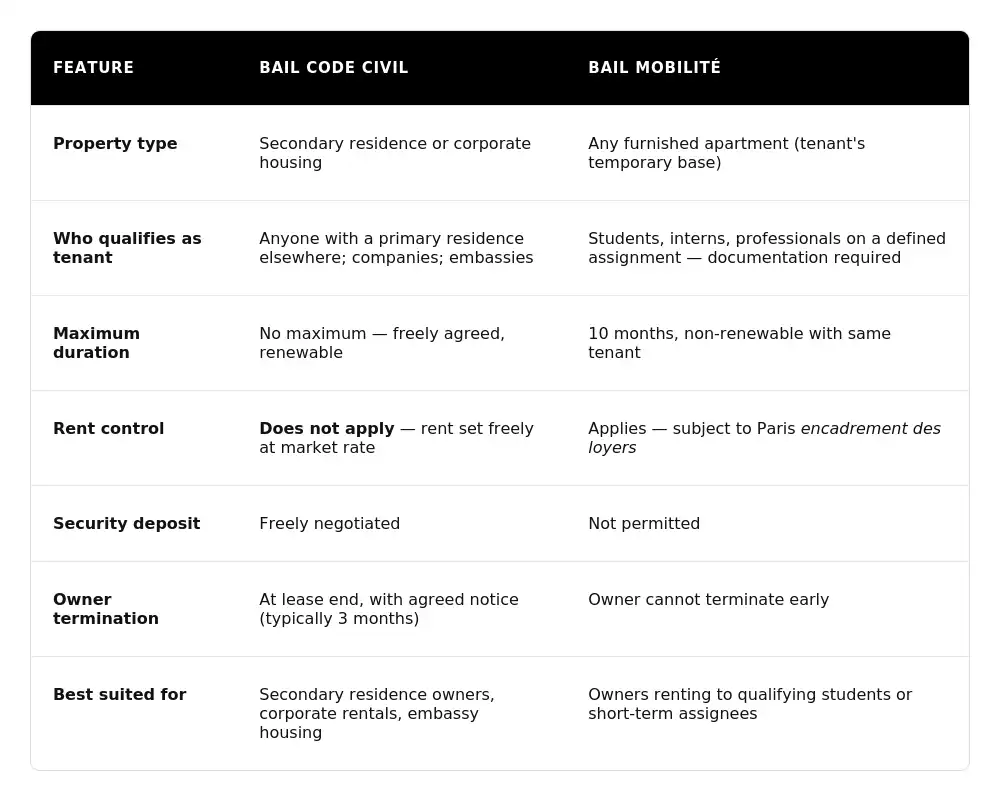
The single most important difference is rent control. The bail mobilité is subject to Paris’s encadrement des loyers, which caps rent by district, property size, and construction period — and in the central arrondissements, those caps routinely fall short of market rates for quality furnished apartments. The bail civil carries no such restriction. For a well-furnished Haussmann apartment rented to a corporate tenant, that distinction is financially significant.
The bail civil also imposes no maximum duration, and the tenant pool — companies, embassies, executives — tends to be more financially stable than the qualifying categories the bail mobilité targets.
The practical verdict for Paris second-home owners:
If your Paris apartment is a secondary residence, the bail civil is almost always the more advantageous instrument. It allows market-rate rents, flexible terms, and access to a corporate and diplomatic tenant base. The bail mobilité is better suited to owners who specifically want to rent to qualifying students or short-term assignees and are prepared to operate within the rent control framework.
One Risk to Manage with the Bail Civil
If a tenant can demonstrate to a judge that the apartment was their only residence when the lease was signed, a court can reclassify it as a primary-residence lease — retroactively applying rent control and stronger tenant protections. This is managed by documenting the tenant’s existing primary residence in the lease and favoring corporate tenants where possible. When a company signs directly on behalf of an employee, the reclassification risk is effectively eliminated.
What Owners Need to Know Before Renting
Most International Owners Work with a Rental Manager
In practice, most international buyers work with a local rental manager who handles tenant sourcing, lease execution, inventory reports, rent collection, and day-to-day oversight in exchange for a percentage of rental revenue. A good manager knows which lease structure fits a given property and tenant, how to draft or review a bail civil correctly, and which corporate or diplomatic tenant profiles to pursue. Paris Property Group works with a network of trusted rental managers and can connect buyers with professionals who specialize in the international owner profile.
Energy Performance and Legal Minimums
As of 2025, properties with a G energy rating cannot legally be rented. F-rated properties face the same restriction in 2028. Both lease types require the apartment to be furnished for daily living — bedding, kitchen equipment, tableware, seating, storage, and lighting at minimum. For corporate tenants the practical standard is considerably higher: move-in-ready, fully equipped, nicer furnishings and a property in very good condition.
Taxation
Rental income from both lease types is declared under the BIC regime. Most owners use Non-Professional Furnished Lessor (LMNP) status, which offers either a flat-rate deduction or full expense and depreciation accounting. A French accountant familiar with furnished rental property is worth consulting before the first lease is signed.
Best Neighborhoods for Medium-Term Rentals
Demand is strongest in arrondissements that combine residential character with proximity to major employers, international institutions, and transport. The 7th arrondissement — embassy row — generates the most consistent bail civil demand in Paris, with diplomatic missions regularly seeking well-furnished apartments for staff. Saint-Germain-des-Prés (6th) attracts academics and senior professionals, with strong rents for renovated Haussmann apartments. Le Marais (3rd and 4th) is popular with American renters and corporate tenants alike; scarcity keeps vacancy low. The 16th draws transferees from financial services and organizations including the OECD. For bail mobilité demand, the Latin Quarter (5th) and the République corridor (10th and 11th) generate steady inquiry from graduate students and younger professionals.
In the central arrondissements, furnished apartments rented at market rates under a bail civil regularly command above €35 per square meter monthly. Owners who maintain properties to corporate standards and work with professional managers tend to have less vacancy between tenants.
Why This Matters for Buyers and Investors
For buyers evaluating a Paris purchase, the rental question is part of the investment thesis. The short-term rental path is largely closed for secondary residence buyers unless the property is already legally authorized for short term rentals — the bail civil is the functional replacement, and for quality apartments in the central arrondissements it can generate market-rate income without the regulatory exposure of the Airbnb model and frankly without the wear and tear of airbnb tenants.
It is important to note that ownership structure interacts with rental strategy. How the property is held — individually, jointly, through an SCI — affects which lease instruments are available, how rental income is taxed, and how the property transfers at inheritance. These decisions are best made before purchase, not after, with guidance from a notaire who specializes in international buyers. Understanding the Paris buying process and the rental landscape together gives buyers a complete picture of what owning a furnished Paris apartment actually looks like over a five- or ten-year horizon.
Frequently Asked Questions
What is the difference between a bail civil and a bail mobilité?
The bail civil applies to secondary residences and corporate housing; rent is freely set with no control ceiling and duration is flexible. The bail mobilité applies to qualifying tenants (students, interns, assignees), is capped at ten months, cannot be renewed with the same tenant, and is subject to Paris rent control.
Are medium-term rentals legal in Paris?
Yes. Both the bail civil and the bail mobilité are legally recognized residential leases, not subject to the 90-day short-term rental cap for permanent residents, city registration requirements for tourist rentals, or Le Meur Law restrictions.
Why is the bail civil generally better for second-home owners?
Paris rent control does not apply, allowing market-rate pricing. There is no maximum duration. The tenant pool — companies, embassies, senior executives — is more financially stable. And when a company signs the lease directly, the main legal risk (tenant reclassification as primary residence) is effectively eliminated.
What should owners know before renting their Paris apartment?
Verify the DPE energy rating — G-rated properties cannot be legally rented as of 2025. Have the lease drafted by a notaire experienced with furnished rentals. Consult a French accountant about LMNP status. And engage a local rental manager — for many international owners, professional management makes sense.
The Bottom Line
The medium-term furnished rental market in Paris is more structured — and more owner-friendly — than most international buyers realize. For those who own a secondary residence in the city, the bail civil provides a legal framework that is flexible, free from rent control, and well-matched to the corporate and diplomatic tenant base Paris consistently attracts.
Contact Paris Property Group to learn more about buying or selling property in Paris or to be introduced to a trusted mortgage professional.
Social Cookies
Social Cookies are used to enable you to share pages and content you find interesting throughout the website through third-party social networking or other websites (including, potentially for advertising purposes related to social networking).